



A Society That Adapts to People – Not the Other Way Around
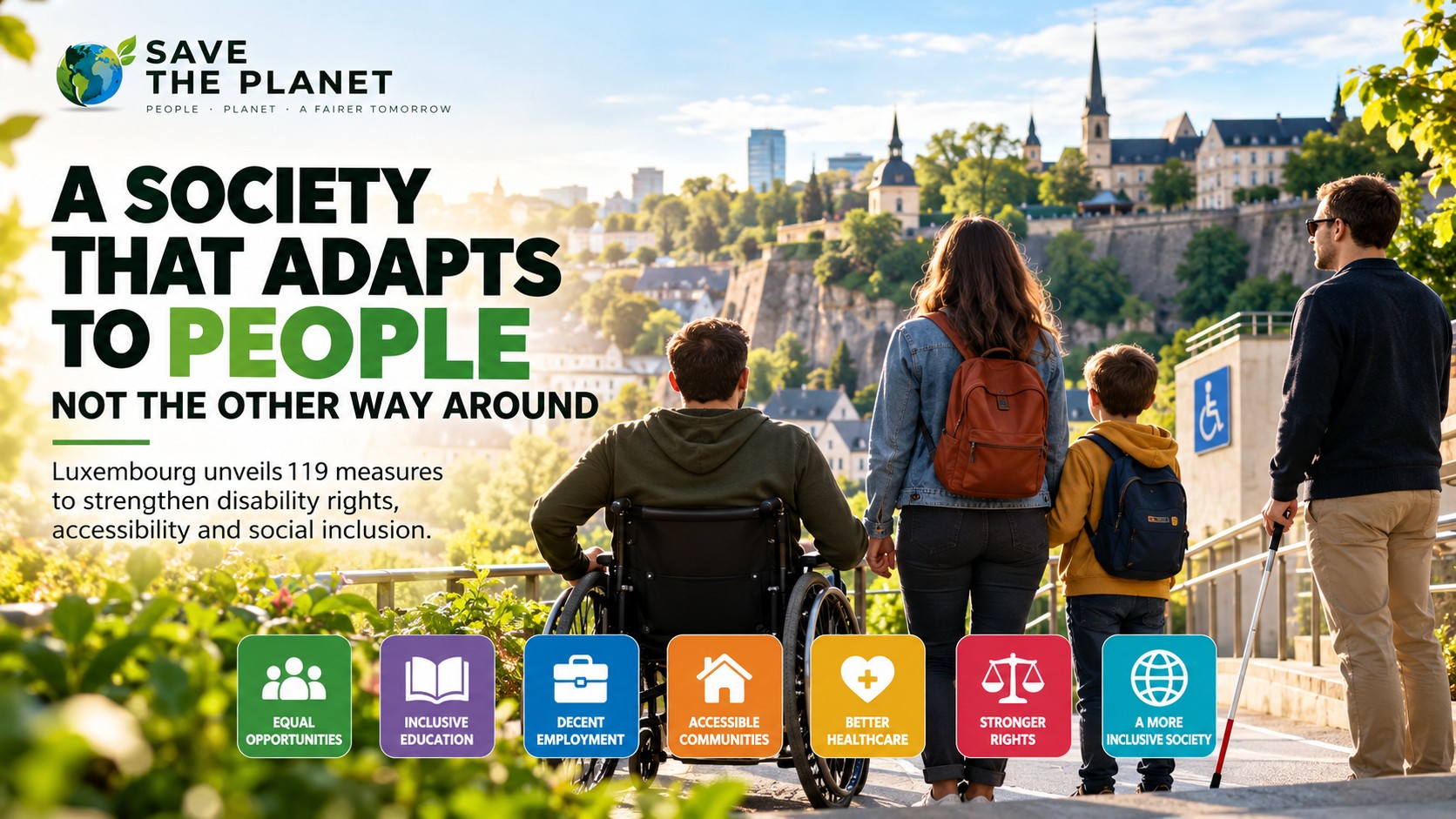
Luxembourg unveils 119 measures to strengthen disability rights, accessibility and social inclusion.
Luxembourg | 19 October 2026 | Save The Planet – Society & Sustainability
Inclusion Is Not a Privilege. It Is a Fundamental Right.
What if the greatest obstacle facing people with disabilities was not their disability itself, but the society around them?
This question lies at the heart of Luxembourg’s newly presented third National Action Plan for the Rights of Persons with Disabilities.
With 119 concrete actions and 50 objectives, the government aims to remove barriers, strengthen individual autonomy and ensure that everyone can participate fully in society.
The central message represents an important change in perspective: People with disabilities should not have to adapt to society. Society must adapt to them.
94,000 People – A Reality We Cannot Ignore
According to Luxembourg’s 2021 census, approximately 14.6% of the population, representing more than 94,000 people, reported living with a disability.
Disabilities take many forms. Some affect mobility, vision or hearing. Others involve intellectual, neurological or invisible conditions.
Yet many of the challenges people encounter are created or reinforced by their surroundings.
An inaccessible building, an unsuitable workplace, a poorly designed digital service or an education system that fails to accommodate individual needs can transform a manageable condition into a significant disadvantage.
Accessibility is therefore not simply about installing ramps or lifts. It means rethinking how our communities, institutions and services function.
From Education to Employment: Seven Areas of Action
The new national plan addresses seven interconnected priorities:
- Equality and non-discrimination: Ensuring equal rights and opportunities.
- Accessibility and participation: Removing barriers in public services, culture, sports and everyday life.
- Autonomy and self-determination: Supporting independent living and personal decision-making.
- Education and youth: Improving early identification, educational support and inclusive learning environments.
- Healthcare and social protection: Making medical services and support systems more accessible.
- Employment: Improving opportunities in both public and private sectors.
- International cooperation: Advancing disability rights beyond national borders.
One particularly important initiative concerns the earlier identification and support of neurological and developmental conditions in children.
The government also intends to strengthen specialised educational competence centres, improve coordination between healthcare and schools, and make music education more inclusive.
Independence Must Replace Unnecessary Dependence
Another significant development concerns legal guardianship.
Luxembourg is preparing reforms intended to better balance protection with individual freedom.
Judges would be required to consider less restrictive alternatives before imposing guardianship measures. Such measures would also be time-limited and subject to review.
This reflects a fundamental principle: Protection should never unnecessarily come at the expense of personal autonomy.
The same philosophy applies to housing, employment and access to public services.
True inclusion means giving people the opportunity to make their own choices, participate in decisions and live with dignity.
Social Sustainability: The Often-Forgotten Dimension
At Save The Planet, we believe sustainability extends far beyond environmental protection.
A sustainable society must also be socially responsible, economically inclusive and designed to serve people with different needs.
This connects directly with the United Nations Sustainable Development Goals, particularly:
- SDG 4 – Quality Education: Inclusive and equitable learning opportunities.
- SDG 8 – Decent Work and Economic Growth: Equal access to meaningful employment.
- SDG 10 – Reduced Inequalities: Removing structural disadvantages.
- SDG 11 – Sustainable Cities and Communities: Creating accessible, inclusive and resilient living environments.
Whether we are designing buildings, transport systems, workplaces or digital infrastructure, accessibility should be integrated from the beginning rather than treated as an expensive correction afterwards.
Inclusive design is not only a social responsibility. It is also an investment in better infrastructure, greater participation and long-term societal resilience.
119 Promises – But What About Results?
The national plan was developed through cooperation involving 20 ministries, people directly affected by disabilities and human rights organisations.
Its implementation will be monitored annually, with an independent external evaluation planned after five years.
However, experience demonstrates why accountability matters.
Luxembourg’s previous disability action plan for 2019–2024 saw 95% of its measures initiated, but only 58% fully completed.
This does not erase the progress achieved. It does, however, underline the difference between political commitments and measurable change.
The success of the new plan should ultimately be judged not by the number of measures announced, but by the barriers actually removed and the improvements experienced in everyday life.
Our Perspective: A Better Society Is Designed for Everyone
The discussion surrounding disability rights should not be limited to assistance, compensation or special arrangements.
It is about how society defines normality, participation and equal opportunity.
A wheelchair-accessible building also benefits older people and parents with pushchairs. Clear communication helps people with different cognitive and linguistic abilities. Flexible working arrangements can benefit employees with and without disabilities.
When we design society for diversity, we improve it for everyone.
Luxembourg’s new action plan is a welcome step towards a more inclusive future.
But governments cannot achieve this transformation alone. Employers, architects, engineers, educators, service providers and citizens all have a role to play.
The challenge is no longer simply to recognise that barriers exist.
It is to remove them.
Because a truly sustainable society is not one in which everyone is expected to fit the same mould. It is one in which everyone has a place.
Save The Planet – Sustainability is environmental, economic and social.